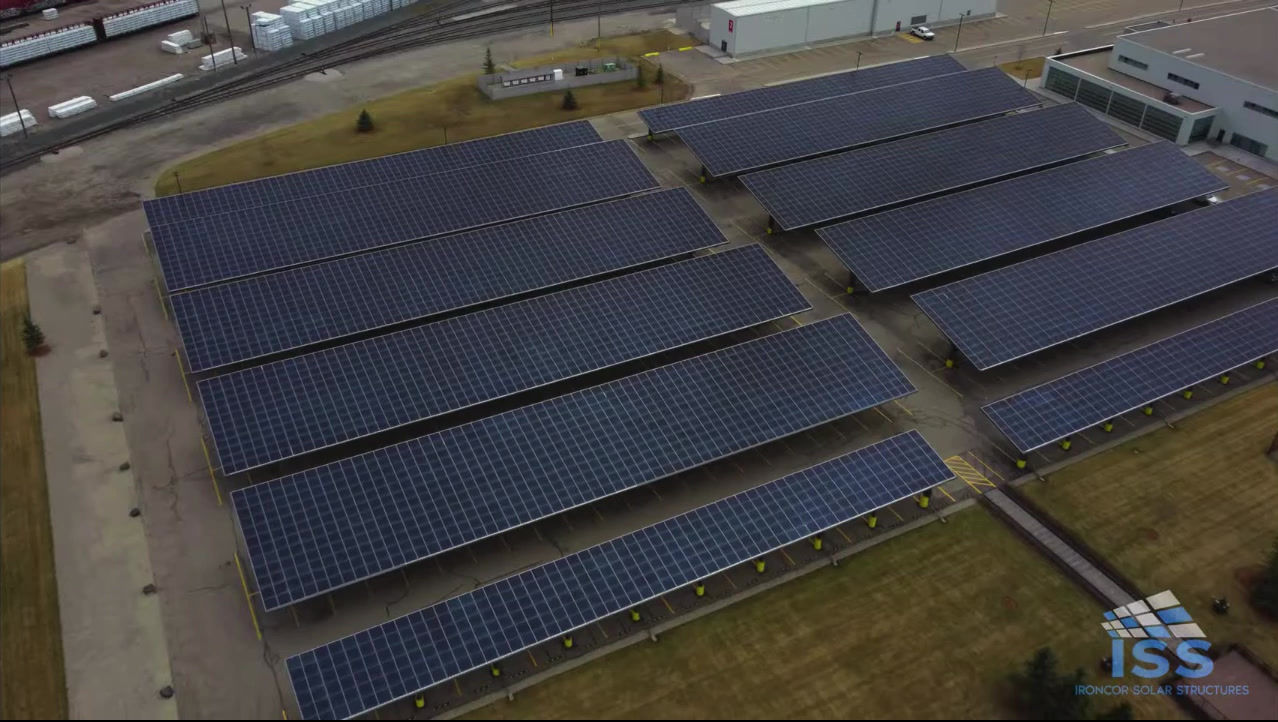


Solar Carport Financing for Commercial Properties
A parking lot is often one of the largest underperforming areas on a commercial property. It requires maintenance, lighting, drainage, and liability management, yet rarely produces a return. Solar carport financing changes that equation by allowing owners to convert existing parking areas into energy-generating infrastructure while preserving capital for core operations.
For commercial, industrial, institutional, and multi-property organizations, the decision is not simply whether solar makes sense. The more useful question is how to structure a project so its energy savings, asset-protection value, and potential EV charging revenue support the investment over time. The right financing approach should fit the organization’s balance sheet, tax position, energy objectives, and ownership horizon.
What Solar Carport Financing Should Accomplish
A solar carport is a construction and energy project in one. It combines foundations, structural steel, drainage coordination, electrical infrastructure, solar equipment, utility interconnection, and often EV charging. Financing must recognize the full value of that integrated asset rather than treating it as a conventional rooftop solar installation.
A well-structured transaction can help an owner manage the upfront cost while creating measurable operating benefits. These may include lower purchased electricity costs, more predictable energy expenses, covered parking for employees or visitors, protection for fleet vehicles and equipment, and support for corporate or public-sector sustainability commitments.
The financial model should also account for the costs avoided by improving the parking environment. Covered spaces can reduce weather-related exposure for vehicles, improve the user experience, and create a more durable foundation for future charging infrastructure. These benefits may not appear as a direct utility-bill credit, but they matter when evaluating the total return on the site.
The Main Solar Carport Financing Structures
The best structure depends on who needs to own the asset, who can use available incentives, and how much capital the organization wants to commit at the outset. There is no single best option for every property.
Direct Ownership
With direct ownership, the property owner funds the project through available capital or a conventional capital budget and owns the solar carport from commissioning onward. This approach typically provides the greatest long-term control over the asset, energy savings, and any applicable tax or incentive benefits.
Direct ownership can be attractive for organizations with strong liquidity, a long property hold period, and a clear need to reduce operating costs. It also gives the owner full discretion over expansion, including future battery storage or EV charging additions. The trade-off is the initial capital requirement and the need to evaluate the project against other internal investment priorities.
Construction and Term Debt
Many commercial owners use project debt to spread the capital cost across the expected useful life of the infrastructure. A construction facility can fund engineering, procurement, and installation, then convert into term debt after the project is operational.
This structure can preserve working capital while matching debt service to the energy savings and other economic benefits the carport produces. It is especially relevant for organizations that want ownership but prefer a predictable repayment schedule. Lenders will generally assess site control, borrower strength, energy-production assumptions, utility arrangements, equipment warranties, and the quality of the engineering and construction team.
Lease Financing
A lease can make solar carports more accessible when a business wants to avoid a large upfront payment or preserve borrowing capacity for other investments. Depending on the lease structure, the organization may make fixed periodic payments while using the electricity produced on site.
Lease terms require careful review. Decision-makers should understand who owns the asset during the term, who receives incentives or depreciation benefits where applicable, what happens at the end of the agreement, and how maintenance responsibilities are assigned. A lower initial payment is valuable only if the full-term economics remain aligned with the organization’s objectives.
Third-Party Ownership or Energy Service Agreements
Under a third-party ownership model, an external investor may finance and own the solar carport while the host site agrees to purchase electricity under a long-term energy service agreement. This can reduce or eliminate the host’s upfront capital commitment.
The host benefits from electricity at an agreed pricing structure, while the project owner receives the revenue and may retain the available financial incentives. This model can work well for organizations with limited capital budgets, tax-exempt entities, or owners that prefer to focus on their core operations rather than asset ownership.
Its central trade-off is control. The host site must be comfortable with a long-term agreement, defined escalation provisions, access requirements, and provisions for a sale, refinancing, or redevelopment of the property. Strong contract design is essential.
Build the Business Case From the Ground Up
Financing follows project economics. Before selecting a capital structure, owners need a credible assessment of what the specific site can produce and what it will cost to deliver.
Energy analysis should begin with interval utility data, demand patterns, electricity rates, and expected on-site consumption. A solar carport is most valuable when generated electricity offsets consumption that would otherwise be purchased at retail rates. If production regularly exceeds site load, the economics will depend on local export rules and compensation rates.
The physical design is equally important. Parking geometry, vehicle circulation, snow and wind loading, subsurface conditions, drainage, utility pathways, fire access, and electrical service capacity all affect installed cost. A lower-priced preliminary concept may not reflect the structural, civil, and electrical work required for a durable commercial installation.
For this reason, a finance-ready proposal should include more than a panel count and estimated annual generation. It should provide a site-specific concept, preliminary engineering assumptions, installation scope, production model, capital cost range, operating assumptions, and a clear explanation of what is included or excluded.
Evaluate Returns Beyond the Electricity Bill
Electricity savings remain the primary financial driver for most projects, but they are not the only source of value. A commercial evaluation should consider the carport as a long-life site improvement with multiple functions.
Owners should quantify, where practical, the value of vehicle and equipment protection, parking improvements, lighting upgrades, EV charging readiness, and potential tenant or customer value. Fleet operators may place a different value on covered vehicles than a retail center. A municipality may prioritize public charging access and climate commitments. An industrial facility may focus on reducing peak-period electricity costs and improving resiliency planning.
A disciplined model also includes ongoing expenses. These can include operations and maintenance, insurance, monitoring, inverter replacement allowances, financing fees, and reserve requirements. Optimistic production forecasts or understated lifecycle costs can make a project look stronger on paper than it will be in operation.
The right decision metric varies by organization. Some owners prioritize simple payback. Others use net present value, internal rate of return, debt-service coverage, or a defined energy-cost reduction target. For institutional buyers, budget certainty and avoided capital outlay may matter more than owning the asset outright.
Incentives Can Improve Economics, but Should Not Carry the Project
Tax credits, rebates, accelerated depreciation, clean-energy grants, and utility programs can materially improve solar carport economics. Their availability, timing, and transferability vary by jurisdiction, project type, ownership structure, and the status of the applicant.
Organizations should avoid building a business case around an incentive that has not been confirmed. Some programs require preapproval before construction starts. Others have domestic-content, labor, community-benefit, or reporting conditions. A project team should identify applicable opportunities early, assign responsibility for applications and compliance, and model a base case that remains commercially sound without relying on uncertain funding.
For tax-exempt organizations and public entities, third-party ownership may provide a practical way to capture value that the organization could not otherwise use directly. That benefit should be weighed against the cost and contractual duration of the energy agreement.
Questions to Resolve Before Signing
The financing conversation should start early, ideally during feasibility and concept development. Waiting until final design can limit options or create avoidable redesign work.
Before committing, decision-makers should have clear answers to several practical questions:
Who owns the carport, solar equipment, and renewable-energy attributes during and after the financing term?
How are utility savings measured, and what production assumptions support the financial forecast?
Which party receives incentives, tax benefits, renewable-energy credits, or other environmental attributes?
What happens if the property is sold, refinanced, expanded, or redeveloped?
Who is responsible for monitoring, maintenance, repairs, insurance, and performance guarantees?
Can the system accommodate planned EV charging, storage, or additional solar capacity?
These questions are not legal fine print. They determine whether the project remains an asset as the property and organization evolve.
A Strong Delivery Partner Reduces Financing Risk
Financiers and owners both benefit from a coordinated delivery model. Solar carports involve decisions that cross disciplines: structural engineering affects solar layout, electrical design affects charging capacity, and construction sequencing affects whether parking can remain operational during installation.
Working with a qualified partner that can coordinate design, engineering, manufacturing, installation, and financing support reduces handoffs and gives stakeholders a clearer view of cost, schedule, risk, and accountability. For a custom solar structure, proven construction capability is as important as projected energy output.
Sunport Structures approaches solar carports as commercial infrastructure built around the site, the parking operation, and the owner’s financial objectives. That perspective helps ensure financing supports an asset designed to perform for the long term.
The most productive next step is to evaluate the parking area as part of the property’s energy and capital plan. With credible site data, a tailored design, and financing aligned to ownership goals, a parking lot can begin contributing to lower operating costs and stronger long-term property value.


